Market Calendar
Volatility has a schedule
Earnings, Fed decisions, inflation prints, expirations — the scheduled events that inflate implied volatility and then collapse it. Ninety days ahead, in your timezone.
18 event types · 90 days ahead · 13 timezones
Coverage
The events that actually move the surface
Curated rather than exhaustive — the releases that reliably reprice volatility, not every number an economist publishes.
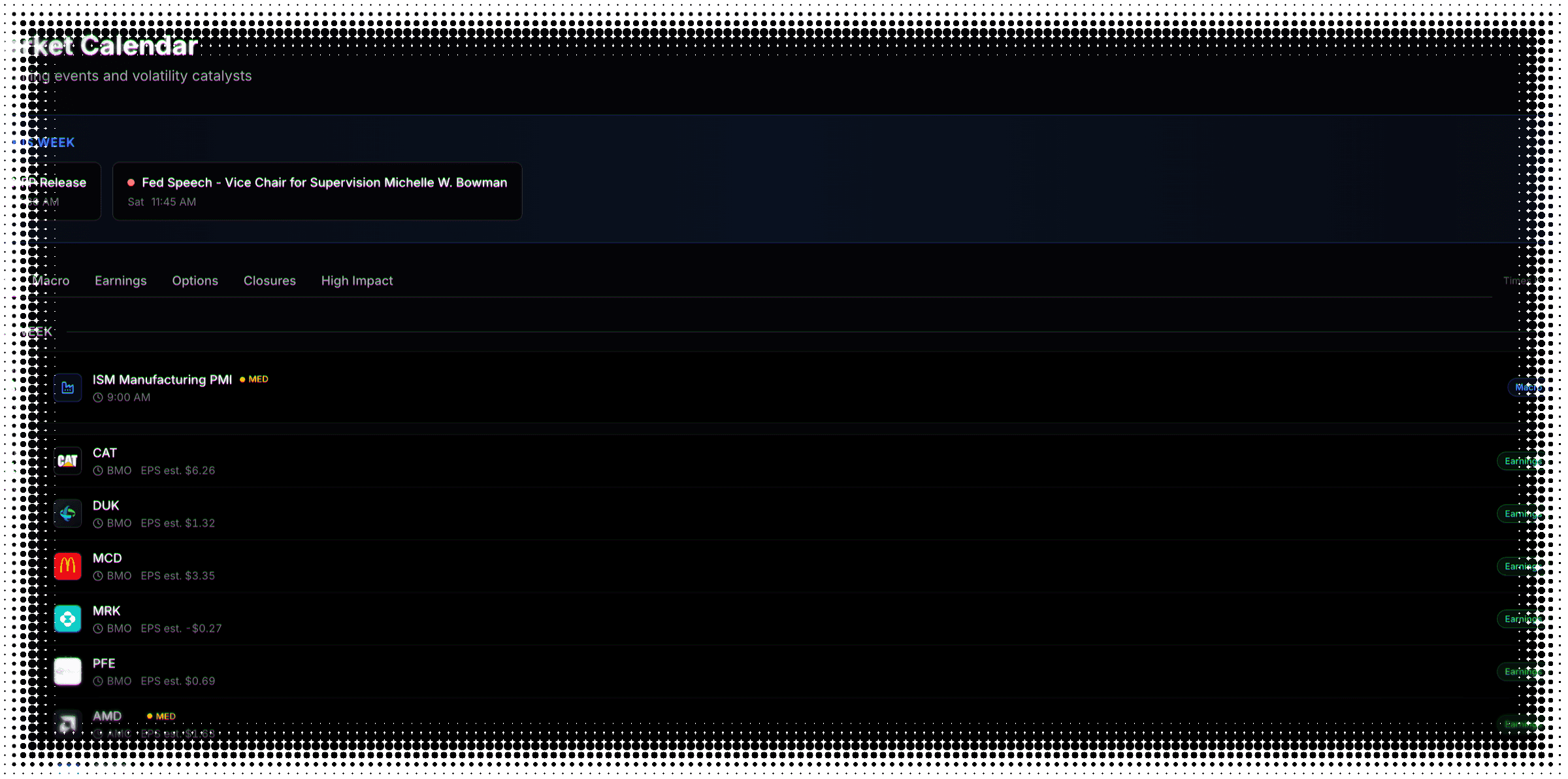
Ninety days of earnings, macro releases and expirations — arriving in bursts, not evenly. The week ahead is surfaced first, and closures are the one lane that keeps going, out to twelve months.
Reading a row
It tells you which dates can still move
A calendar that presents a guess as a fact is worse than no calendar.
Impact
Marked when it matters
High- and medium-impact events carry a badge. The routine ones stay quiet, so the board never shouts.
Confidence
Dates that can still move
A projected earnings date is tagged Unconfirmed rather than shown as settled. Most are confirmed by the company.
Timezones
In your timezone, handled properly
Thirteen zones, set once in settings. What converts, and what deliberately doesn't.
Converted
Your day, not New York’s
An evening US event files on your next calendar day, using the offset actually in force on that date.
Left alone
Before the open stays before the open
Session markers name a position in the US session, not a clock time. Converting them would be worse than useless.
Earnings rows are one click from the ticker’s full analysis — the volatility surface, the term structure, and how its past reports actually went.
Market calendar FAQ
What to know about trading around scheduled events
Eighteen types of scheduled event across four groups: company earnings with their consensus estimate and session, macro releases including FOMC decisions and minutes, CPI, PPI, PCE, payrolls, GDP, ISM and retail sales, options events including monthly expiration and VIX expiry, and the full schedule of market closures and early closes.
Because implied volatility is priced around scheduled events. It builds into an earnings report or a Fed decision and collapses once the outcome is known — which is the entire mechanic behind selling premium into an event, or deliberately avoiding one. Knowing what lands inside your expiration, and when, is the difference between a considered trade and an accidental one. The week ahead is pulled out at the top of the board so the things closest to being priced are the first thing you see.
Ninety days for earnings, macro releases and expirations, and twelve months for market closures. Closures run further on purpose: planning a position around a holiday or an early close needs more notice than planning around a data print, and holiday dates are known years ahead where an earnings date often isn’t.
Most are confirmed by the company; the rest are projections based on prior reporting patterns, and those are tagged Unconfirmed rather than shown as settled. There is no matching “confirmed” badge — a date without the tag is one the company has announced. Dates further out are likelier to move, and the board rebuilds daily, so confirmations land as they are announced. Roughly a quarter of the earnings dates on the board at any time are still projections.
No, and that’s deliberate. It carries the releases that reliably move implied volatility rather than every figure an economist publishes — so no jobless claims or housing starts, and no IPOs, dividends or stock splits. Earnings coverage is the large-cap universe the rest of the platform analyses, and the scope is US markets: US exchange holidays, US macro releases, US expirations.
Not remotely, and the board doesn’t pretend otherwise. Earnings arrive in bursts around reporting season and thin to one or two a week in between; macro releases run closer to monthly. That unevenness is the useful part — the quiet stretches are as informative as the crowded ones when you’re choosing an expiration.
Six views — everything, macro, earnings, options, closures, or high impact — and you pick one at a time rather than combining them. The week ahead and the closures section stay on screen whichever you choose, so narrowing to earnings never hides an upcoming holiday from you.
High- and medium-impact events carry a coloured dot and a label; everything else is left unmarked. That’s a deliberate restraint rather than missing data — badging all of it would make the badge meaningless, and most earnings rows are routine. The marking is a text label as well as a colour, so it doesn’t depend on being able to distinguish the two.
Whichever of the thirteen supported zones you pick in settings — it defaults to US Eastern and is not auto-detected, so if you’re outside the US it’s worth setting once. Conversion uses the offset actually in force on that date rather than today’s, and if an evening US event lands on your next calendar day it’s filed on that day rather than quietly showing the wrong one.
Because they aren’t clock times. They name a position relative to the US trading session, and that position is the same wherever you happen to be sitting — so rendering “before the open” as a local hour would be worse than useless. All-day events like expirations and holidays are left on their US date for the same reason.
Neither. The board is forward-looking only — once a day has passed it drops off rather than accumulating history behind you. And there are no alerts, notifications or reminders, no calendar subscription or export, and no per-ticker filtering: it is the same board for everyone, meant to be read rather than configured. Where a value is missing it is simply left out, never filled in with a placeholder number.
Macro dates come from the official published release schedules, exchange holidays from the market’s own calendar, and options expirations aren’t fetched at all — they’re calculated from the rules that define them. Earnings dates are the company’s own announcement where it has made one, and a projection from prior reporting patterns where it hasn’t, which is what the Unconfirmed tag distinguishes. The whole board rebuilds daily, so a confirmation shows up the day after it’s announced.
Still have questions? Contact support
Know what's coming before it's priced in.
We're getting ready to launch. Join the list and you'll be first in the door.